Mat Messerschmidt
Yellowstone, the Power of the City, and “Political Coding”
Adam Smith’s Wealth of Nations tells the surprisingly riveting story “Of the Rise and Progress of Cities and Towns” in Europe, from the fall of the Roman Empire to early modernity. The presence of many human beings in one place allowed them to specialize their labor assignments as never before – allowed them, in other words, to lean into the power of the division of labor, creating an economic explosion. The wheelers, dealers, and craftsmen that built the cities became a destinal class in world history, exponentially magnifying the wealth of nations and ensuring that the seat of this wealth, the focal point of capital, was the city. Smith calls this class the burghers, which originally simply means the city-dwellers.
The part of Smith’s story to which I am referring is then accepted more or less in its entirety by Karl Marx. Where Smith used the English word burghers to refer to the fateful class of city dwellers, Marx employs either the German equivalent, Bürger, or the French word, also roughly equivalent in its original meaning, bourgeoisie (the former is usually used when an adjective is needed, the latter, as a noun). The main difference between Smith’s and Marx’s discussions of the new urbanites is the extent of their focus on class conflict, which is much greater in Marx.
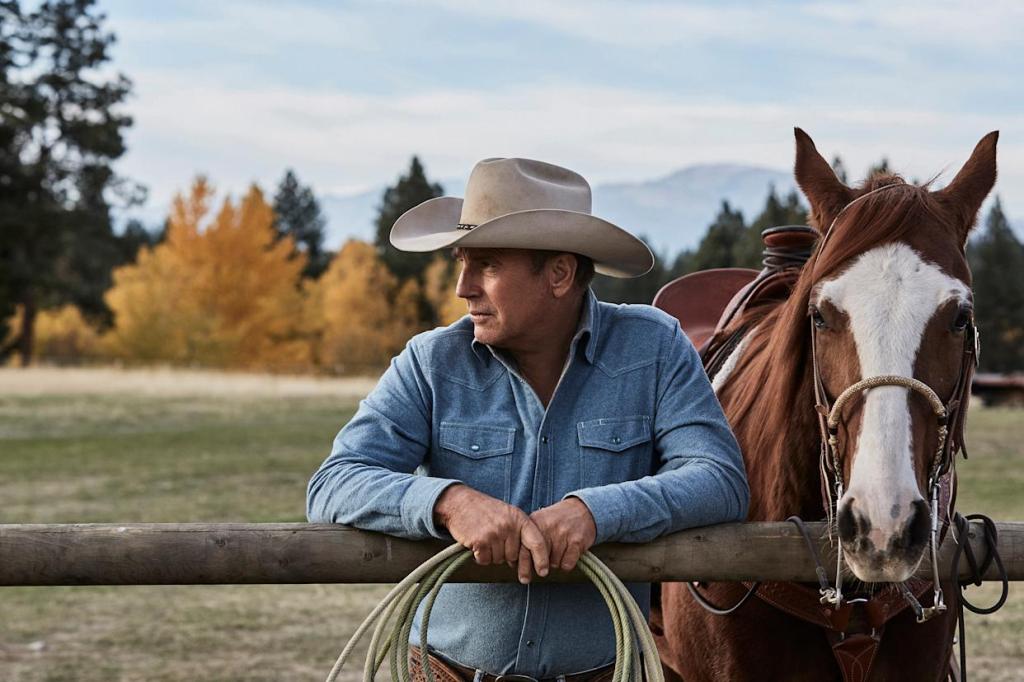
While the focal point of Marx’s historical story is usually the city, where the bourgeoisie have brought the proletariat, the urban working class, in order to take the fruits of their labor, Yellowstone tells the story of the resistance to the burghers mounted by the countryside, in a time in which the power transition from country to city as limned by Smith and Marx is ancient history, an accomplished fact – in which the world of the country is a world gone by. The country, in the world of the show, has been emasculated and eternally threatened by the power of the city, which never really appears on screen. Its feudal lords fight for relevance, and its poor fight for their endangered way of life. The city, in the form of real estate developers from Los Angeles and then New York, seeks quite literally to extend itself into Montana, to pave much of it in concrete and make it urban. The goal, of course, is profit, and the forces of the city do not care that this would put an end to the dying, overlapping worlds of the largely white cowboys and farmhands and the Indians of Broken Rock reservation. They want to do this by seizing the ranch of John Dutton’s family (Dutton is the main character) via eminent domain or other means and employing the Indians’ ancestral lands (which include the Duttons’ ranch) for infrastructure construction, including an oil pipeline. The five seasons of Yellowstone are the story of these threatened Montana groups, in uneasy states of unity and disunity, attempting the Sisyphean task of trying not to be swallowed by urban capital. Finally, in the last two episodes, they succeed in doing so, but only by means of an act of radical rural solidarity involving extravagant self-sacrifice.
Although one can borrow Marxist language to speak of Yellowstone’s central conflict, much commentary on the show has focused on the notion that it is “coded conservative,” the way nearly everything in our culture today receives a political coding. Yellowstone can be subjected to the Marxian framing I just gave it and can simultaneously be coded conservative because it represents the modern city, land of the burghers, as the great disenchanting evil of modernity. This antipathy toward city capital could come from Marx or MAGA.
More MAGA than Marx, though, is the fact that the city forces that come to Montana systematically misunderstand themselves in relation to the Montanans. The urbanite whom we see the most of is Summer Higgins, the radical Portland environmentalist who arrives in Season 4 leading the Free Earth movement, which aims to disrupt the proposed oil pipeline. We know Summer through her affair with John Dutton. She assumes Ubers are available hours from the nearest town, presumptuously takes for granted that a Montana cook can easily whip up a gluten-free vegan breakfast option, insults the same cook for serving for dinner the game he has hunted himself, and also for serving duck, because “ducks mate for life.” These details reflect her history as an inhabitant of a world with a radical array of options, which is to say, a world of wealth – the wealth of the city, which the Duttons (rich themselves, of course) and the rest of Montana understand to be the world of the establishment, the culturally, financially, and politically empowered world. Yet Summer, the political activist, is clueless, at least initially, as to the privileged background betrayed by her behavior, and clearly takes herself to be a rebellious, anti-establishmentarian voice in Montana and in the family in which she finds herself. To Summer’s air of moral superiority we can add a different kind of condescension from the city’s business leaders and politicians, who repeatedly tell the Duttons and the Broken Rock leadership that they don’t understand what’s good for them – that the airport, the ski resort, the casino, etc. are their best option. All of this suggests a lack of understanding on the part of the urbanites regarding both the world they have invaded and the meaning, for the residents, of their intrusion into that world. These expressions of the presumptuousness and entitlement of urban America rely on old tropes, familiar by now to every American.
Less predictable, perhaps, was Yellowstone’s ending, which strongly undercuts the show’s reading by critics who had portrayed it as a white fantasy that won an audience by strategically indulging Red America’s fundamentally white rural imaginary. In order to avoid losing the ranch land by failing to cover the taxes owed on it, the Duttons essentially give the land to the Broken Rock Indians, selling it to them for $1.25 an acre (the price at which it was acquired from the Indians in 1883) in exchange for the promise that it will never be sold or subjected to development. The land, in other words, will remain in the hands of the brave rural Montanan forces who have resisted the incursions of coastal city capital. The show depicts this conclusion as bittersweet, but there cannot really be any doubt that, in the moral universe of Yellowstone, the fact that the grasping hands of New York and Los Angeles are ultimately turned away from Montana counts as a great moral victory.
Perhaps Yellowstone, like everything else in our culture nowadays, had been too rigidly “coded” in political terms by its commentators from the start. But it is true that the show’s creator, Taylor Sheridan, knew far before the end of the series that the show’s viewership was disproportionately right-leaning. It is also true that in the Trump era, the Republican voting block is more racially diverse than it has been at any other point in modern times. It may be that catering to Red American biases, which is what critics accused the show of doing through many seasons, would not mean exactly what urban progressive cultural commentators assume it would mean – that it would not mean simply indulging in a whitewashed cultural fantasy. It may be that Chief Thomas Rainwater of the Broken Rock Indians, who tirelessly resists the power of New York and California in the name of community and tradition, is a more sympathetic figure to Red State viewers than is Dan Jenkins, a white, hard-driving alpha land developer from Los Angeles who wants to build a casino in Montana and sneers at everything Montanan. It might not offend Red State viewers the way the way progressives assume it would that Rainwater is the only central character in Yellowstone who has a more or less uncomplicatedly happy ending (to be fair, it is easy to find reports of complaints regarding a “woke” ending, but these are usually second-hand reports often citing one or two X users).
I don’t in fact believe that Sheridan was obsessively thinking in the politicized terms that we have become unable to think without – I don’t, in other words, think that the makers of Yellowstone mulled over the political implications of the show’s every plot twist. If Yellowstone’s appeal is to be understood in politicized terms, we should allow those terms to challenge the prejudices of our own political pieties: the political resistance to the city and a concern for dying communal worlds need not be racially backwards. But I would ultimately articulate the show’s appeal differently: it creates a world whose distance from the tired political terms that have come to dominate our cultural discourse often comes as a tremendous relief.
INDICAȚII DE CITARE
Mat Messerschmidt ,,Yellowstone, the Power of the City, and “Political Coding”’’ în Anthropos. Revista de filosofie, arte și umanioare nr. 2 / 2026
Acest articol este protejat de legea drepturilor de autor; orice reproducere / preluare integrală sau parțială, fără indicarea sursei, este strict interzisă.


 ANTHROPOS. REVISTA DE FILOSOFIE, ARTE ȘI UMANIOARE