Mat Messerschmidt
Masculinity, Femininity, and the Styling of the Self
What is style?
This month at Anthropos we consider the topic of “style and human being.” What role does the concept of style play in the humanness of the human being? How does the human being develop its own style? What is style? With the following reflections on the meaning of style, I take myself not to be asserting any new, cutting edge theory, but only to be reflecting on the way we use the word, as Aristotle sometimes starts his philosophical discourses.
There are many kinds of styles. There is writing style, musical style, speaking style. If we take the sense of the word “style” which can be understood without a qualifier, not as this or that kind of style but just as style, then we can note that this privileged sense of the word “style” belongs to clothing style, to the way we stylize the appearance of our bodies. This might be seen to reflect the centrality of the body to the self: we are the body before we are anything else.
Style names a mode of expression. The very word “expression” implies something to be expressed. The word, then, implies that the self, that which is often taken to be “inside,” gives itself to the visible world, or to that which we often speak of as the “outside” of experience. But this giving is not a mere reproduction: a dance style is not merely a communication of the content of a body’s flesh, or its libidinal disposition, or its health, etc. It manifests the energy of the body but brings something new and potentially vital into the world, something that is not already there by the mere fact of the body’s existence before it starts to dance.
My style, then, cannot be your style, even if we can speak of similar styles, as in the writing styles of Ernest Hemingway and Knut Hamsun, or the cinematographic styles of Robert Bresson and Paul Schrader. My style cannot be your style because the self that is expressed is never the same in any two cases. Furthermore, there is great style, and there is mediocre style, but my style perfected and your style perfected will never be the same, and there will always be a limit on our ability to compare two styles, such that “great” might be discernable from “mediocre,” but to rank the greatness of Hemingway’s style against Hamsun’s might ultimately not be possible.
All this implies that the process of realizing one’s style is both a finding of what is already there – a finding of oneself – and a creating of that which is not given by the mere givenness of the self. We tend to focus on the creative side in our discussions of style, but the other side of style, the side that involves discovery of what is already there in us, may be just as important. Even in the extreme case of acting, in which an acting style seeks to enable us as viewers to suspend our knowledge of the identity of the actor, the actor will have a style that is identifiable over the course of an entire career. We will recognize that style as the style of Audrey Hepburn or of Jimmy Stewart, even as we are engrossed in a film whose success depends on our becoming absorbed in their adoption of an alternative identity. The style of Stewart’s acting will always be a Stewart-ing of Stewart, an expression of the self. Great acting, the discovery of a great acting style, will depend on the discovery of that self, on the discovery of Stewart by Stewart.
Taken in its broadest sense, style seems necessary to ensure that life is worth living. Only with style will human beings ever create anything of elegance or beauty. To establish one’s identity, a matter, like style, both of finding a self that is already there and of fashioning a self over time, could be said to be a stylizing of the self.
Style and Gender
One tremendously important element of our identity is our gender identity. It is my sense that the word “identity” has been weakened, flattened, in the era of identity politics, and not only by those who practice what is usually called identity politics. We have come to speak as if a personal identity could be yielded exhaustively by a single word identifying membership in a group. For instance, in the context of gender, we speak of “identifying as” a man, woman, non-binary person. We speak of racial or ethnic or national identities. These are important aspects of our identity, but none of them on their own yields a person, a fact which our speech about identity often seems to have forgotten – and even these identities take more to truly incorporate into the person we are than a simple self-designation, than an “identifying-as.” We can, for instance, burn our passport and renounce the politics and heritage of our homeland, but we do not thereby convincingly pass ourselves off to the average onlooker as the product of some other country – nor do we thereby do anything to change the simple fact that we will almost certainly always think, in deep and often undetectable ways, in the manner of the nation in which we were raised. There is nothing more common than the individual who ostensibly hates their country, yet serves almost as a paradigmatic exemplar of their national ethnicity.
This can happen because the person we are is not entirely chosen, but is, to the contrary, to an important degree the person we found ourselves as, as the result of biology and of ethnic, familial, and personal history. As a result, the range of styles open to us is never limitless, because style is an expression of the self, and the range of selves from which we can select is clearly finite. One can, therefore, choose something as superficial as one’s political stances vis-à-vis one’s homeland, but one cannot simply choose one’s ethnicity, or even the range of places on earth in which one will feel at home.
By the same token, one can choose one’s pronouns, but one cannot choose without limitation how the self into which one was “thrown” (to use Martin Heidegger’s term in a context he never considered) will be expressed along the lines of gender, whether this expression takes the form of outward appearance or inner monologue. Our sex hormones play a role in forming our brains and our libido; if, as teenagers or adults, we change our sex hormones through medical therapy, the developmental effect of our prior endowment of sex hormones on our bodies during our formative years will remain. No matter how determined we are to reject the cultural lessons of our early gendered upbringing, the legacy of those lessons will always be with us, albeit perhaps in a conflictual and complicated way. To use the language we used above, we never have complete control over how we will style our own gender, because we do not have complete retroactive control over the forces that have formed the self that gendered behavior expresses.
To assert simply that this means that men ought to be what men always were, since they were born as men, and that women ought to be what women always were, since they were born as women, would be intellectually lazy and would stunt cultural innovation. But there is also a grave danger in speaking as if “masculine” and “feminine” are words that only name historical forms of oppression. Figuring out who we are as gendered beings will never be entirely a matter of innovation or creativity, just as style is not just about creation but is also about expression of what is already there. We can innovate with the drives, instincts, and body types we were born into, but we cannot change them limitlessly. Masculinity and femininity are neither historically static nor exceptionlessly liberating stylizations of the gendered person, but it is likely that they are enduringly recognizable across epochs precisely because the flesh we find ourselves in – the libidinal patterns, the capacities, and the cultural memories of our bodies – does not change radically from generation to generation, and the stylizations of the self named in the words “masculinity” and “femininity” resonate with the perduring tendencies of our flesh. If style is an expression of self, then the gendered stylization of the body is the expression of a self that was, to an important degree, prepared for us throughout evolutionary history, and then through cultural history.
This history has prepared us for many things, and it has empowered us to do more than simply follow its lead. It has equipped us to have a greater degree of control over our individual destinies than any other organism on this planet has ever had. This is why a book like Judith Butler’s famous 1990 work Gender Trouble is possible in human culture: we are not shackled to the styles and the modes of embodiment of the past. Butler says we can “subvert” the historical gender structures we find oppressive (to verbalize Gender Trouble’s favorite word, “subversion”). I find something troubling, though, not in this claim as stated, but in a clear and exceptionless assumption, on Butler’s part, regarding what this claim implies. Over the book’s nearly 300 pages, as well as in virtually all discourse surrounding gender that takes its cue from Butler, we find the presupposition that historical gender structures will in fact always be oppressive, that self-liberation will always take the form of the “subversion” of old modes of gendered expression. It may well be that some people experience themselves as men born into women’s bodies, or women born into men’s bodies – but it is also true that very many people experience themselves as men born into men’s bodies, and women born into women’s bodies. To suggest that human beings liberate their gender expression only insofar as they cast off the historical stylizations of manhood and womanhood is potentially to stifle a path to self-discovery for such people.
To even raise this concern might strike some as hyperbolic: don’t we live in a world in which the great majority of us express ourselves in largely conventionally gendered ways? Of course we do, and it does not trouble me at all that some of us do not. It seems clear, though, that the overt stigmatization of historically inherited modes of gender expression is not limited to some small avant garde clique, but has rather become generalized in progressive and urban cultural spaces in the United States and beyond. A topical example was given by the recent discussion on The New York Times’s “Popcast” of the way Taylor Swift’s most recent album The Life of a Showgirl has been taken to task by her progressive fans for its allegedly conservative vibes emanating from its “conventional expressions of heteronormative sexuality.” Such attacks are not some conspiracy against heterosexuality undertaken by gay people: straight, “heteronormative” progressives themselves are treating any sign of gender traditionalism in their own lives as something to be obscured or denied. This according not to J.D. Vance or Tucker Carlson, but to Helen Lewis, progressive feminist at Atlantic magazine, who writes of a generalized culture of “boring straight people identifying as queer through accounting tricks.”
One of the gifts of liberal society is that it allows us such a vast array of acceptable lifestyles – that it puts us in a position to even be able to conceive of such a thing as a life-style, a style of life, to conceive of the individual pursuit of a stylization of one’s own life and one’s own self. But this gift, which can and should represent the great adventure of liberalism, remains a gift only if the self does not have to be denied in order to accept it. When we find ourselves culturally encouraged to suppress the call of the flesh, to suppress the deepest part of the self through “accounting tricks” because that self is seen as disappointingly conventional, something has gone wrong, and the great adventure has been halted before it begins.
There was a time when progressive gender politics stood for the acceptance of new stylings of the self. With time, more and more focus has been dedicated to the rejection of old stylings of the self. Masculinity as understood hitherto is “toxic”; femininity as understood hitherto is a trap. This approach risks narrowing the horizon that social progressivism intends to broaden, and it may compel some to condemn and stifle age-old elements of the self when those elements seek expression – when they seek expression, that is, in the form of traditional masculinity or femininity.
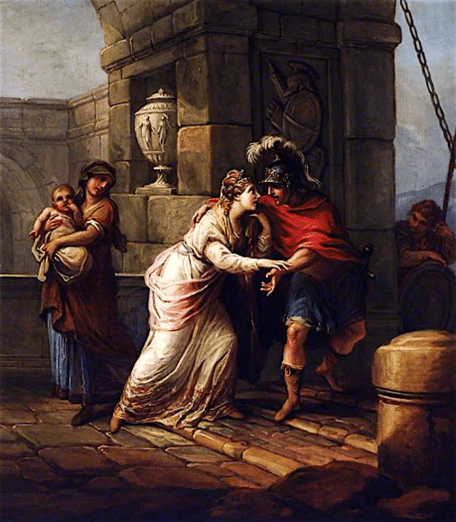
I have admittedly been speaking of “style” in a rather capacious way in this consideration of style and gender, but let me close with a thought on art, the realm to which “style” in its narrower meaning is most commonly applied. In a cultural milieu in which “conventional expressions of heteronormative sexuality” cause discomfort, or even invite Puritan condemnation – imagine, expressions of heterosexual libido on a pop music album!– have we stunted our ability to respond to some of our tradition’s most beautiful depictions of masculinity and femininity? Of Hector and Andromache’s last farewell, or of Penelope’s persistence until the return of brave Odysseus? If liberal society is to be open-minded regarding styles of life, let it be open to the old as well as the new, and not too quick, as its greatest ideological opponents always are, to label stylings of the self, or lifestyles, as toxic.
INDICAȚII DE CITARE
Mat Messerschmidt ,,Masculinity, Femininity, and the Styling of the Self’’ în Anthropos. Revista de filosofie, arte și umanioare nr. 4 / 2026
Acest articol este protejat de legea drepturilor de autor; orice reproducere / preluare integrală sau parțială, fără indicarea sursei, este strict interzisă.


 ANTHROPOS. REVISTA DE FILOSOFIE, ARTE ȘI UMANIOARE
