Cristiana Popp
Artificial intelligence – fear and hope
Intelligent life is somewhere else, not in silico. I am not afraid of artificial intelligence. It will never be as good a doctor as me, it will never write as interesting a text as me and, most certainly, it will not crack better jokes than me. Just because artificial intelligence is a tool serving people, like a new wheel, a new steam engine, a new computer. It is not, by far, an equivalent of the printing press in the development of mankind, because it will not bring a similar progress, neither as intensity, nor as time and space expansion.
The world is bustling with the fear of the exponential increase in the neuronal networks and their functions. The professionals are terrified they will lose their jobs. That starting tomorrow we won’t need translators, teachers, researchers, drivers, doctors, call-centre operators, air traffic controllers or writers. That all will be done by engineers feeding the intelligent neuronal networks with all the knowledge in the world and, thus taught, machines will do all these jobs and others I cannot think of right now. It would be enough to understand how artificial intelligence works, based on immense matrices made of the data received from humans, to know that we can keep both our control and our supremacy, as long as they are real and supported by strong values. The complex crafts, that need the information to be integrated into an own system of thinking and understanding, will not disappear. Only the repetitive jobs, subject to rules that are simple, clear and perfectly reproducible, will no longer be here. Where the idea, colour, thought, understanding patterns come into play, the power of artificial intelligence stops and the human mind takes over.
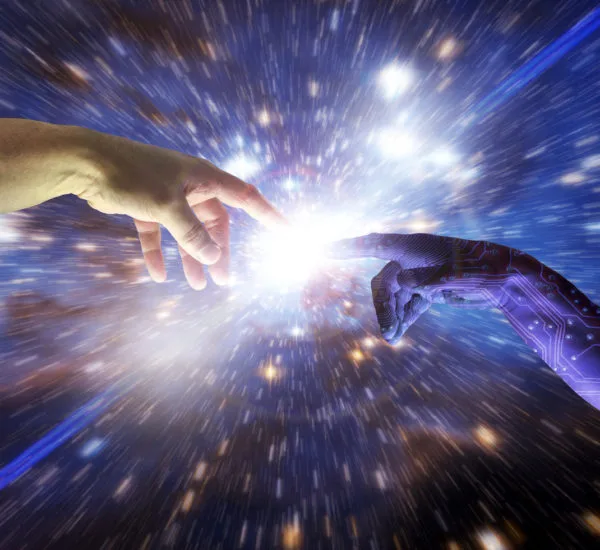
Others are afraid that, one day, the artificial intelligences will coalesce to destroy humanity, either on a reason supplied by humans themselves: we are hurting the planet or we are prone to self-destruction, or to remove the tip of the food chain in order to replace it. Although I have to confess that this looks like a more plausible scenario, I think that the enforcement of the traditional ethical norms to the development of the structures endowed with artificial intelligence will be here to protect us this time around, as it has protected us from other inventions potentially lethal at an individual, group or species level.
In an extraordinary short story (Profession), Isaac Asimov describes a dystopic world where people are split into two categories: the ones acting strictly at the command of texts imprinted on audio tapes and the ones writing the tapes. If we take care to always write the tapes and demonstrate that we are the most intelligent creature on this planet, artificial intelligence will only remain a tool improving our lives and solving the issues becoming the most pressing: decrease in the population of Western countries, decrease in the number and quality of specialists, reduction of the labour capacity, especially by refusing the hard labour. And when we do not understand anymore that none of us will be able to write the tapes, the end will be anyway close, artificial intelligence or not.
Like all the great inventions of mankind, artificial intelligence will bring, without any doubt, besides good things, a whole lot of bad things, like tremendous changes to the labour market and to education. We will have to teach our children and youngsters how not to cheat by having the neuronal networks do their school homework for them. Because learning is, besides intelligence, the secret of the people writing the tapes, of the ones also controlling the neuronal networks with their mind, but also the masses of ignorant and controllable people. But it will also bring added value to our work and free time for relaxation or learning, as well as solution for the lack of qualified labour. We ourselves will have to learn the weak spots in the thinking of neuronal networks and ways to go around or correct them. We will probably have to get out of our comfort zone, that is the one of the Supreme Being, without any competitor, and to become more conscious of the mechanisms by which we can foster and maintain this superiority. There will be new jobs, and the old ones will change. But, as the engine has not replaced either the workers or the farmers, most certainly artificial intelligence will never replace the actual human intelligence. It will probably give more chances to impostors, pseudo-specialists and competence simulators. But maybe it will also give us more time to expose them and to really select an elite that will write the tapes, more relevant and more useful than ever. And maybe then, free from the simple time and energy consuming routines, human intelligence will be able to forcibly erupt to reach its highest potential.
INDICAȚII DE CITARE
Cristiana Popp, „Artificial intelligence – fear and hope” in Anthropos. Journal of Philosophy, Arts and Humanities nr. 4/2023
This article is protected by copyright law; any reproduction/copying in whole or in part without acknowledging the source is strictly prohibited.


 ANTHROPOS. REVISTA DE FILOSOFIE, ARTE ȘI UMANIOARE