Mat Messerschmidt
The Fragility of Wonder and the Place of Great Books
The first words of Aristotle’s Metaphysics, arguably his most important work, are “All men by nature desire to know.” Wisdom, he then says, is knowledge of the “first causes and the principles” of things. Philosophy, φιλοσοφία, as the love (φῐ́λος) of wisdom (σοφία), pursues these causes and principles. But how does one find one’s way to philosophy? Aristotle’s answer is clear: “In wonder is the beginning of philosophy.” Only the wonder induced by the encounter with a wonderful world can motivate philosophy as the pursuit of the most profound knowledge. But, reading between the lines, we can perhaps say more: if, as Aristotle’s first sentence suggests, the humanness of the human being is bound up with our pursuit of knowledge, then only in wonder can the humanness of the human being properly unfurl.
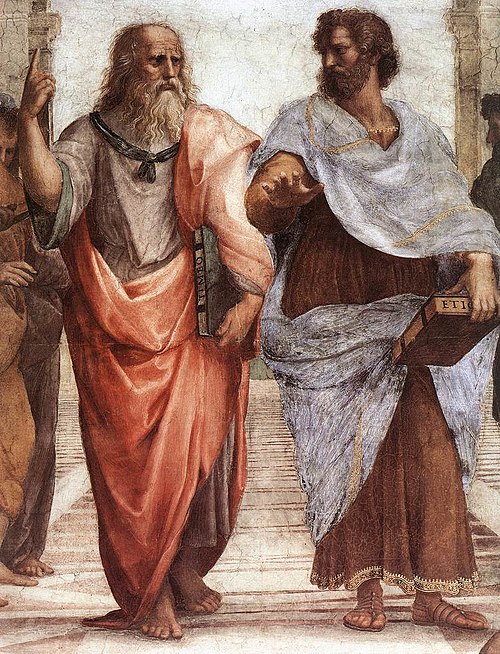
This seems right to me, but there is something missing. Note the universality of Aristotle’s claim: “For all men begin, as we said, by wondering that things are as they are.” Do all men achieve wonder, in Aristotle’s time or in ours? I do not think so. Aristotle’s articulation of the interplay between wonder (Θαυμάζειν), knowledge, wisdom, and philosophy is itself wondrous – but it is wrong in evincing no anxiety whatsoever that this dynamic could ever come under threat. Wonder is fragile, and access to it can be lost.
It seems to me that wonder is not only largely absent from our late modern culture today, but also that it is implicitly denigrated, not just by the way we actually approach the obtainment of knowledge, but even by the things we say quite explicitly about knowledge acquisition. The tenor of our public discourse implies that to be knowledgeable is to stand in admiration of nothing, to wonder at nothing. In our political debates, the dominant rhetorical stance on all sides is that of the jaded skeptic, too well informed to believe that “the system” “works,” or that capitalism works, or that the government or the international order works. In education, we champion liberal arts learning, or even sometimes Great Books curricula, on the grounds that they will nurture “critical thinking.” The assumption in both politics and education, in other words, is that that critique is at the foundation of thought, that intellectualism is criticism.
We do want critical thinkers, but critique is not as foundational as wonder, and any educational system that does not nurture wonder will have failed at properly orienting young human beings to the pursuit of knowledge – will have failed at properly orienting them toward their own humanity, if we follow Aristotle, as here we should. If the world that confronts the young potential knower is a world without wonder, there will be nothing to love in that world, and no good reason to know that world in the manner of wisdom. Without wonder, the world encountered by the intellect cannot exert the erotic pull that awakens the desire for understanding. Without understanding, critique means nothing: critique gains its value only once we have come to grasp something worth evaluating, something of potential value. If critique alone comes to be the paradigmatic form of intellectual inquiry, we have lost the foundations of knowledge – and perhaps even put our own humanity at risk, according to the logic of the first sentence of the Metaphysics. If liberal arts education suggests to the young that critique lies at the epicenter of thought, it teaches alienation from what makes us human.
There are limits to wonder, as philosophers from Aristotle to Descartes have always acknowledged. If I do not move from wonder to the pursuit of wisdom – which involves a certain kind of labor and thus a certain kind of discipline – but instead simply remain entranced by whatever is wonderful, I am not so much a wise man as I am a worshipper, or the subject of hypnotism. I am by no means wise, and by no means a philosopher, simply by having encountered that which is wondrous. But there is great danger in the adoption of a lexicon wherein wonder, naivete, and gullibility are all synonymous terms. We seem to be living in an epoch that has performed exactly that conflation, and has thereby mistaken intellectual laziness for hard-headed sobriety.
Can we find our way back to the fragile beginning of philosophy? To reclaim wonder would demand of us that we unlearn habits that we at this point hardly even realize we have acquired. One does not reverse long-developing cultural tides simply by deciding to do so. Still, it seems too hopeless to say that wonder is irrevocably lost to us today.
One simple behavioral change we could make is simply to consciously and explicitly search out the wonderful, and to call it wonderful when we find it. The “Great” in “Great Books,” for instance, affirms the wonderful in our cultural inheritance. That Great Books could be at the center of an educational program confirms Aristotle’s conviction that wisdom could, or even must, find its foothold in the encounter with that which is wonderful.
To call a book great indicates that it orients us towards goodness, truth, or beauty in a new way, but typically in a way that brings us to a state of invigorated questioning, rather than some self-assured certainty regarding a new set of definitions: encountering the wonderful, we begin to wonder. Knowledge, when it arrives, intensifies the questioning, rather than usurping it: it amplifies the erotic pull of the world upon the knower.
If we reject as naïve or old-fashioned the notion that books can do this, then we must affirm the conclusion of any student who comes to believe that books are not worth reading. The cultivated, lifelong desire to read is inextricable from the experience of wonder.
If wonder is fragile, then the desire to pick up a book will always be fragile, as well. And without books, the love of wisdom, φιλοσοφία, has a hard road to survival.
INDICAȚII DE CITARE
Mat Messerschmidt ,,The Fragility of Wonder and the Place of Great Books’’ în Anthropos. Revista de filosofie, arte și umanioare nr. 3 / 2026
Acest articol este protejat de legea drepturilor de autor; orice reproducere / preluare integrală sau parțială, fără indicarea sursei, este strict interzisă.


 ANTHROPOS. REVISTA DE FILOSOFIE, ARTE ȘI UMANIOARE
