
Horia Vicențiu Pătrașcu
The religious war against unhappiness
The release of the volume On happiness, published at the Publishing House of the West University of Timișoara, coordinated by Liviu Cocei and Ion Cordoneanu, gave me the opportunity to continue the reflection on the theme addressed in the text that we published in this volume.[1]
We will only reiterate here the aspects that are related to the current theme of the Anthropos file. As the problem of happiness has an immediately noticeable connection with the binomial war-peace, conflict-concord and aggression-cooperation. In order for the reader to have a well-defined meaning of the term “happiness”, we will extract those features common to all definitions given throughout the history of this concept, regardless of the chosen perspective: the eudaimonist, the hedonist, the utilitarian, the deontological perspective and so on. Therefore, the happiness translates into the maximum degree of authentic fulfillment of the human being – located in eternity, either in an extensive sense (as eternity, eternal duration, immortality) or in an intensive sense (as a moment suspended, removed from the ordinary flow of time and unaffected by the passing thereof).
Thus, unlike the ordinary pleasures and joys of life by which certain “parts” of the human being are satisfied, often successively and contrary (the sexual pleasure is contrary to the pleasure of sleeping or eating), the happiness “satisfies” the human being in its entirety: when we are happy we feel that we lack nothing, that everything we could want is present, we therefore have the feeling of a beneficial totality. Also, unlike the ordinary pleasures and joys of life, happiness is genuine, that is, it is not illusory, it is not disproved later and it has no dire consequences for the subject of happiness. Finally, unlike the ordinary pleasures and joys of life, happiness, as the previous definition shows, is imperishable, it cannot be canceled by the passage of time (either in the sense of permanence, the perpetuity of the state of happiness in a paradisiacal world, or in the sense that happiness is part of the category of those acts that once produced cannot be canceled, not even by the disappearance of the subject of the happiness).
Another feature present in all the philosophical definitions given to happiness is that this total state of the human being is the positive result of a struggle, a conflict, and an antagonism. Except for those idyllic, poetic, and nostalgic visions which attribute happiness to early ages or primitive peoples (where even this attribution makes sense only in opposition to the corruption of the maturity or the civilization), the happiness as a conscious act of a fully developed human being is, in all cases, the result of a belligerence towards the lower pleasures, towards the state of inequality or inequity, towards sin, towards death, towards ignorance, towards the non-recognition of the other and so forth.
It is no accident that happiness was seen as an end in itself, as a finality that no longer leads to any other. The happiness is therefore shown as a result of an essential struggle, deeply defining the human being. The happy free themselves from a state of essential (constraining) precariousness into their authentic and full being, thus becoming truly free. The happiness and the freedom are shown to be consubstantial. (You cannot force anyone to be happy as the good cannot be imposed by force and so on).
In the Romanian language, to forgive originates in the word to release. We thus find in the deep layers of language a possible link between happiness and forgiveness. But can we call the happy forgiven of that essential precariousness of we spoke of? For forgiveness is always granted by someone else. In a religious horizon we can talk about the equivalence between the happiness and the forgiveness – because the fight you fight with sin, with temptation or with the mortal condition – is not completed, by definition, by your own powers, but by a blessing, by the grace granted by God. Not coincidentally, in the Sermon on the Mount the happy are actually blessed (Μακάριοι).
On the contrary, to believe that happiness (salvation) can be achieved on your own, without the divine grace is to make yourself guilty of the worst sin, the sin of pride. The happiness, the forgiveness, is therefore a blessing granted by God, a blessing that can arise independently of merits (gratia gratis data), by rewarding them, or by not descending at all, despite all the efforts to obtain it.
This absolute dependence on an instance characterized, in the end, by chance is completely alien to the ancient philosophers for whom happiness is the rational, almost rigorously calculable result of an existential endeavor: setting the human free from the pain in the body and the suffering within the soul, of fear, of excesses, of ignorance, of vices, of soul disturbance, of adherence to one opinion or another are just as many ways to obtain happiness, imagined as a quiet and free life inside an impregnable fortress.
The happiness of the ancients is autarchic, sovereign, and independent and it is achieved through a struggle that is waged, also within, against a false self and for the acquisition of the authentic self. The liberation and the freedom that the happiness of the ancients represents have nothing to do with the forgiveness, a concept specific to Abrahamic religions.
The forgiveness of the happiness
But can the very happiness make itself the object of forgiveness? Indeed, we find such a strange and unthinkable association in the phrase that Prince Mishkin addresses the young Hippolytus, suffering of tuberculosis, when the latter asks him: “what he can do to die with dignity and peace?” Myshkin then tells him as he brings these notions together for the first time in like so: „Go about your way, and forgive us our happiness!” Happiness therefore becomes, in Dostoevsky’s vision, the object of forgiveness, because it is often the main reason why misfortune turns into unhappiness. Hippolytus, suffering of tuberculosis, is a wretch, a poor man worthy of pity and compassion. He becomes downright unhappy because others are happy, as he thinks.
We are unhappy because we are not happy, but mostly because others are happy, as we are forced to the spectacle, so hard to endure, of the other’s happiness. Free yourself from this constraint that makes you unhappy, but this freedom will not bring you happiness but only the dignity of suffering and death. Here is something placed above happiness itself: the freedom from happiness – the human dignity! We are not far from Immanuel Kant for whom not the happiness but the dignity is the true fulfillment of the human being. Again, you can achieve this liberation on your own, through a struggle against your own soul misery, against grudges, resentments, envy, grumbling and against the „ontic injustice”[2] who made some people uglier, some other people more beautiful, some people stupider, some other people smarter, some people sicker and some other people healthier, and so on.
And yet let’s not so quickly pass over the literal meaning of Mishkin’s phrase: „go about your way and forgive us our happiness.” Of course, in a figurative sense, this way of speaking suggests a staging of Hippolytus’ interiority where the tubercular young man, tormented by resentment, will be able, through personal effort, to overcome his resentment and regain his serenity forgiving the others around him their happiness. But one of the possible conditions of forgiveness, at least in human relations, is that someone asks for forgiveness (V. Jankelevitch).
However, the „forgiveness” that Hippolytus would grant the happy people around him would be a mere sham if no one asked him for it! Forgiving a man or another ex officio is as ridiculous as getting upset for no good reason. In order to forgive, someone has to ask for your forgiveness, and in order to ask for forgiveness, they have to feel guilty. Can there be guilt in the feeling of happiness? Such an idea seems to be as self-contradictory as the squared circle or the good evil. Happiness as the ultimate good and goal in itself is incompatible with the feeling of guilt, a negative feeling, opposed to the presence and the present moment of happiness, because it always sends back – towards an irreversible past – and forward, towards the hope of absolution. Happiness cannot lie under the pressure of remorse, for it, as we have seen, cannot occur, by definition, until after we have freed ourselves from all constraints.
Let’s go even further. By taking this feeling of guilt seriously as an obstacle to the possible happiness – we should ask what exactly could make a man feel guilty about his happiness, thus blocking his access to it? Let’s imagine that we have everything, that we have checked all the conditions to be happy; there is only one thing that prevents us from being happy, and Mishkin’s suggestion is as explicit as it can be: this ultimate something, this ultimate condition is the very unhappiness of the person next to us, of our fellow man. It is Mishkin, in this interpretation, who asks for forgiveness from the unfortunate Hippolytus both for the boy’s unhappiness and for his possible happiness. The happiness, this time, is only possible if you free yourself, reconciling yourself, with the presence of the unhappiness of the person next to you. As if the fact of your happiness directly harms him, rather, as if your happiness produces or contributes to the other’s unhappiness.
The genealogy of the culpabilisation of the happiness/unhappiness: the ontic injustice and the abreaction of the righteous God
Such a pattern of thinking runs through history and we can find it in various versions – in the Book of Job, in the utilitarianism of John Stuart Mill, in the economic-political theory of Marx. All this assumes that the „level of happiness”, with a current formula, depends upon the „level of happiness” of others. If pushed to the extreme, such an assumption is expressed as follows: „no one can be happy as long as there is one unhappy man in the world.” Looking deeper into the very foundations of this assumption we can also see how the feeling of guilt appears as a fundamental obstacle to happiness.
Therefore, the foundations of this assumption are: 1. The specter of a limited amount of good that is distributed in a random, unequal and inequitable way, a phantom that we can call the specter of the „ontic injustice” and 2. The empathy is the ability of the human being to feel the suffering of one’s fellow man. Only together do these two configure the pattern mentioned above: my happiness and the other’s unhappiness cannot coexist.
We find a perfect illustration of this pattern in the Book of Job. The „bet” that God makes with Satan expresses the idea of randomness, of „luck”, of playing with the dice, of hazard – as the foundation of the human destiny. Against this idea stand Job’s friends – whom the reader, in a long tradition of reading and interpretation, has become accustomed to blaming, without taking into account that their intentions are as good as possible and that nothing but the empathy – an otherwise universally respected „ability”– leads them to seek out their friend Job and try to console him. They try to console him, but above all they try to console themselves, because the losses suffered by Job directly impact their own happiness.[3] Such a situation – in which Job’s friends find themselves – is a borderline situation, and the coping strategies used by them are still as current as possible. By struggling with Job’s unhappiness, they struggle to preserve their own happiness or well-being. They actually fight against their own fantasy – that of the ontic injustice, of a limited amount of good distributed randomly, unevenly, and unfairly. For this, they must prove to Job and prove to themselves that there is a reason in the unfortunate events that have befallen their friend, that Job’s sufferings are a punishment for his mistakes and sins.
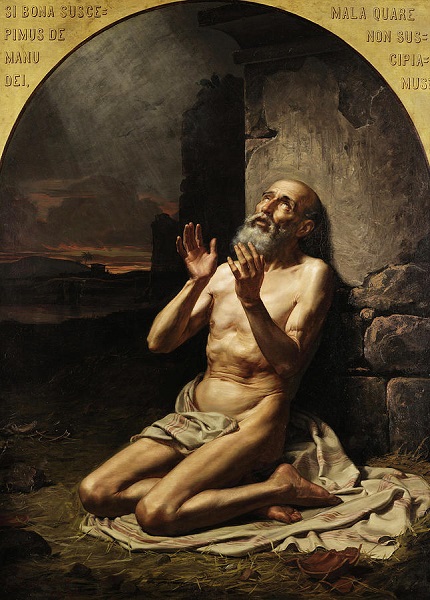
They even present him, in their generosity, with a solution to get out of the present crisis: to ask God to forgive his mistake – about which he has no reason to doubt since it is so clearly proven by the very punishment he endures (his suffering). Job flatly rejects this petitio principii not so much because it excludes the possibility of being wrong (which would have made him guilty of arrogance), but because it rejects the right of God – the almighty – to judge him „individually” – him, a poor human creature.
In fact, in a psychological register, Job resists the attempt that his friends make to make him part of their own coping strategies. The specter of the „ontic injustice” is opposed by the idea of a just God who punishes and rewards according to fault and merit. The idea of a just God is a literally saving idea – but, as we can see, it is an aberration of the primordial fantasy of ontic injustice.
The book of Job gives us in the simplest possible way the psychological genealogy of the „morality” and „religion” of guilt. Because we are empathetic beings, the unhappiness of our fellow man does not leave us indifferent – we suffer because he suffers. To deal with this second-order suffering, produced by the suffering of our fellow man, we have at hand the acts of consolation, the philanthropy, the donations, the aid. And yet no matter how much we suffer for him, we realize that we suffer alongside him – with him, but without being him. We are not only empathic and social beings, but also individual, egoistic and independent beings. The suffering of the second order, the suffering produced by the suffering of our fellow man, risks, the longer it lasts, to irritate us, to frustrate us, to arouse feelings of helplessness and… guilt.
For, behold, I cannot accompany my fellow on the way of his suffering to the end; however compassionate I may be, there are moments when I forget about him, when I rejoice and laugh, because the desire to persist in the being is, with a few exceptions, stronger than the mourning, than sharing the other’s non-being. Could I then follow my own path of happiness by eliminating – as recommended by some ancient philosophical therapeutics, such as the Stoics – the feeling of pity and compassion? After all, if a lifetime of happiness depends on such an amputation, why not? And yet the fantasy of the „ontic injustice” continues to haunt me, for according to this fantasy my happiness produces unhappiness and suffering, my good is another’s evil. Against this fantasy the saving idea of the just God – who punishes the wrongdoing and rewards the merit, is born.
This idea is so precious because it reconciles me first to the other’s unhappiness and, second (!) to my own happiness because now it not only does not appear to the detriment of the other, but is the irrefutable proof of my own merit. Indeed, the price paid is the sacrifice of the innocence of the sufferer, of the unfortunate: he must be guilty. I need to assume he’s guilty to save my own happiness. If I were to convince him, if the unfortunate man were convinced that, through his suffering, he was indeed bearing the consequences of his own actions – he would perhaps even succeed in transcending this suffering of the first instance and converting it into another – much more bearable, sweeter suffering, almost indistinguishable from happiness. At least this is how Christian theologians assure us that it happens with regard to the sincere repentance, the piercing of the heart, the… happy sorrow.[4]
The spirit of capitalism: Proclaiming the guilt of the unhappy
Projecting one’s own guilt onto the sufferer is an almost universal defense mechanism. The manner in which the Protestantism resolves the question of the relation between the providence and the free will is, in this respect, most significant. God has no way of not knowing whether man is saved or not. Unlike Him, man’s eyes are covered by what will be called in the 20th century the „veil of ignorance”. Man must act as if he were chosen, saved, and not damned. Now, the undoubted sign of the future salvation is precisely the earthly well-being, the present happiness, so that the individual will make every effort to prove, humanly speaking, that he is saved… by increasing his earthly wealth. Such a way of thinking which, as we have seen, is a pattern of the human mind illustrated by the attitude of Job’s friends, was unsuccessfully contested by Jesus and by the primitive Christianity which, with its spirit of rebellion, placed the poor, the sick, the sinners and the adulterers close to God.
As we know, despite a few sublime exceptions, such as Francis of Assisi and other recalcitrant Christians, the original Christian message failed to impose itself and dislodge the thought pattern that associates wealth, well-being and happiness with the sign of the divine grace. The Protestantism does nothing but abandon the double language practiced by the Christian church that preaches the value of the humility, the modesty and the poverty from the pulpits of opulent churches and strongly reaffirms that archetype of the guilt of the unfortunate and of the innocence and merit of the happy respectively.
If Max Weber is right and, indeed, the Protestant ethic plays an important role in shaping the spirit of capitalism, then it is not surprising that in today’s society the theory of meritocracy with the related distributive justice is circulating from the pole of (political, economic, but also cultural) power: occupying a certain position in society corresponds to the merits or to the lack of merits of that particular person. Except for the Protestants themselves, very few of today’s competitors are truly aware of the psychological, cultural, and religious determinism at the heart of the “struggle” for happiness and well-being. The obsession with the acquisition of happiness has a deep religious substrate; the struggle for happiness is for the unconscious a true religious war.
The success in a competition, in the social recognition, in the access to a top position is, for the cultural unconscious, an unmistakable sign of the divine election, for the archetypal scenarios remain unchanged. The corollary of this merit theorem is, obviously, the culpability – implicit, subtle or, on the contrary, as explicit as possible – of those who do not succeed, of the “poor”, of the “losers”. This blame that often achieves its goal and many of today’s depressions develop around a sense of guilt that today’s media does not tire of propagating through all channels. The testimony of one of my students was the most enlightening to me: “we, today’s youth, suffer because we see successful people on the internet who are exactly like us, and we are not like them; the question always persists in my mind: why can they achieve that social status, and I can’t?”
Those who, like Job, resist blame and do not admit their guilt/responsibility for their unhappiness develop their own defense mechanisms. They live, without the abreaction of the idea of a just God, the fantasy of the ontic injustice in all its purity. There is a limited amount of good of which some have had – by burglary or by mere chance – more and others less. If the “unhappy” considers that this good was reached “through burglary” – for example through a privileged birth, through the possession of capital, through preferential recommendations, he will not hesitate to blame, in turn, the happy.[5] The happy one deprives him in the most proper sense of a good that would perhaps have been due to him under the conditions of equality. If he considers that no one is particularly to blame for his unhappiness, he will blame everything on the blind fate, on the dice thrown at random by a destiny that has turned out to be against him.
The blaming of the unhappiness has a medicalized form today. It is also true that today we live in an era in which such culpability seems to have more and more basis due to the extraordinary advance of medicine. Most of the serious diseases are, indeed, caused by lack of prevention, the lack of care, by ignoring symptoms, by postponing medical consultation, by a poor nutrition, by the lack of movement and physical exercise and by the non-compliance with the treatment. Moreover – given that all this depends on us – the consequences are strictly our responsibility. The disease no longer comes to punish a sin – more or less known to the sufferer – but it sanctions a mistake or a number of specific mistakes committed by the patient, immediately detectable through anamnesis or blood tests.
We no longer highlight the importance given today to affective dispositions as being directly pathogenic: the stress makes us sick, but no less than any of the negative emotions. If we want to be healthy, we must think and especially we must feel positive. As a reminiscent of the Christian therapeutics that recommended love, including loving one’s the enemy, as a panacea, today’s positive thinking and feeling has the gift of preventing or even curing us of almost all ailments. A well-directed affectivity has the property of preventing and eradicating all ailments. And if we are not able to learn the rules of a good affectivity, the fault belongs entirely to us. Never has a saying like „the dead is guilty for his death” been more relevant!
Against the unhappiness, we have seen, the world wages a religious war as old as the world itself. One of the origins of the just God is, perhaps, precisely the abreaction to the unhappiness of our fellow man. It is no less a religious war against happiness, for the unhappy in turn accuse the happy. This is blame on both sides; no one seems able to forgive the happiness or unhappiness of his fellow man!
[1] Horia Vicențiu Pătrașcu, „Și ne iartă nouă fericirile noastre. O problemă dostoievskiană și câteva posibile soluții” în Despre fericire, coord. Liviu Cocei și Ion Corduneanu, Editura Universității de Vest, Timișoara, 2022, pp. 51-102
[2] I take this term, with a slightly different meaning, from Vasile Dem. Zamfirescu’s volume, The Ontic Injustice, Trei Publishing House, 1995. Here is an excellent description of this affect: the Ontic Injustice is that type of injustice defined by the unpaired, subjectless existence of the object, of the victim without the executioner. For whom could we hold responsible for the omnipotence of death? (…) <Here is the ontic injustice!> you will say to yourself and you will understand why the renunciation of the world, the great departure of the Buddha was not caused by the encounter of the social injustice, but by the spectacle of the ontic injustice in its three privileged poses: the death, the old age and the disease.” (p. 83)
[3] Does the empathy allow us to content with our own satisfaction despite the complaints and lamentations of our fellow man? It seems not! Beggars must be hidden from view in a civilized society, and see how there is a debate in the United States going on upon locking up the poor as they did in France during the Great Lockdown. The poor, the hungry people near us are not a pleasant sight, our happiness is not indifferent to their unhappiness, but it is impacted by the sight of this unhappiness. The story of Buddha, the Blessed Prince, is most eloquent in this respect. He suffers from compassion, he can no longer be happy from the moment he learns that there is sickness, suffering, old age and death.
[4] Πένθος; luctus sau κατάνυξις; compunctio Vezi J. Cl. Larchet, Terapeutica bolilor spirituale, Editura Sofia, Bucureşti,2001, p. 506. See, also, Myrra Lot-Borodine „Taina <<darului lacrimilor>>” în Fericita întristare, Editura Institutului Biblic şi de Misiune al Bisericii Ortodoxe Române, Bucureşti, 1997, p. 135
[5] This fantasy makes Marx build his entire economic theory according to which the surplus value necessarily comes from depriving the worker of a due right.
Translated by Andrei Savinescu
INDICAȚII DE CITARE
Horia Vicențiu Pătrașcu, „The religious war against unhappiness” in Anthropos. Journal of Philosophy, Arts and Humanities nr. 5/2023
This article is protected by copyright law; any reproduction/copying in whole or in part without acknowledging the source is strictly prohibited.


 ANTHROPOS. REVISTA DE FILOSOFIE, ARTE ȘI UMANIOARE